
Planning the veneer support
Standards and regulationsn The planning and design of our brickwork support brackets naturally always comply with current standards and regulations, e.g. the fixing of brickwork is subject to the applicable building regulations. In accordance with the following standards, the support brackets are made of material grade W1.4571/1.4401(A4).- DIN 1045 Concrete and reinforced concrete, design and execution
- DIN 1053 Masonry; calculation and execution
- DIN 1055 Load assumptions for buildings
- DIN 18800 T7 Manufacture, suitability certificates for welding
- DIN 17440/DIN EN 10088-2 Stainless steels
Suggestion for joint design:
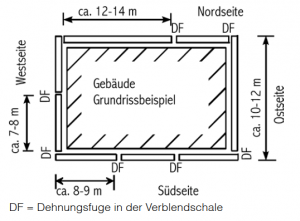
Connected wall sections should not be wider than 7 to 14 m, depending on the geographical location. They are separated by vertical expansion joints.
- The minimum thickness of the outer shell is 90 mm. Thinner outer shells are regarded as cladding, the design of which is regulated in DIN 18515.
- Outer shells of 115 mm thickness (e.g. standard brick format NF or DF) should be supported at height intervals of approx. 12 m. A 115 mm thick outer shell may protrude up to a third of its thickness beyond its support (e.g. in the case of relief formation in the façade due to protruding or recessed stones) if the façade is not higher than 2 storeys or is supported every 2 storeys.
- Outer shells less than 115 mm thick (e.g. Danish standard format, WDF etc.) may not be installed higher than 20 m above ground level and must be supported at height intervals of approx. 6 m. These outer shells may protrude a maximum of 15 mm above their support.
- Masonry shells must be connected using wire anchors made of stainless steel with material numbers 1.4401 or 1.4571 in accordance with DIN 17440; the minimum number per m² of wall area is specified here, depending on the wind load zone, building height and anchor type
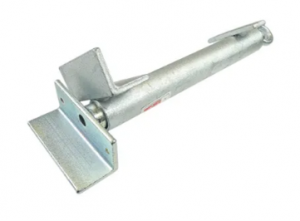
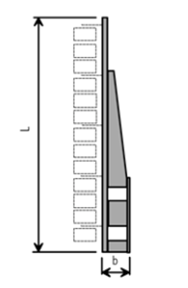
We supply individual brackets for a wide range of load cases and installation situations to suit the planned project. The brackets are manufactured in three load levels: 3.5 KN, 7.0 KN and 10.5 KN. All brackets can be adjusted in height by +/- 30 mm using a set screw in the loop head of the bracket.
Supporting precast elements (facing lintels / precast concrete elements)
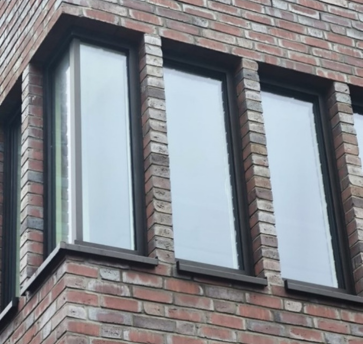
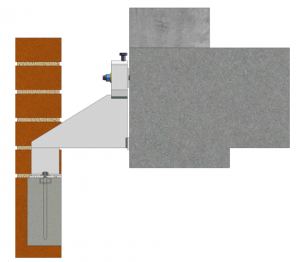
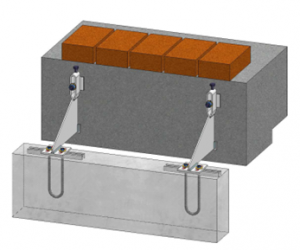
Support of precast brick elements with concrete core depending on static requirements. Suspension is by means of individual brackets. The prefabricated concrete lintel is bolted to the existing slotted holes in the support slab. The precast element has no lateral support (e.g. for lateral expansion joints), but can also be planned to be interlocked with the masonry. Your advantage: The brackets are matched to our prefabricated facing lintels and we are happy to provide our type statics for the prefabricated parts. The system of individual brackets and prefabricated part enables invisible support over façade openings.

Interception of closed wall surfaces
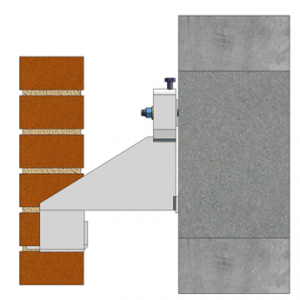
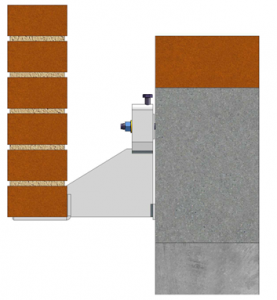
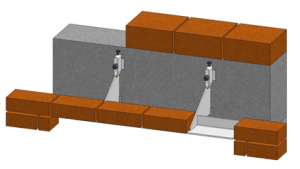
Closed wall surfaces (e.g. for intermediate or base point supports) are usually supported with wrap-around brackets. These consist of one or more bracket backs, which are provided with brackets as supports for the masonry. They can also be used as a secure support over façade openings.
Special cases and special installation situations
For complicated cases, e.g. with challenging building geometry, at building corners, etc., we plan a “sustainable” solution in cooperation with you, the architect and/or structural engineer, otherwise we can produce a suitable bracket for practically any support situation, e.g:- Windposts for perforated masonry or parapet facing anchors if the parapet does not provide a suitable fixing base.
- Bottom view of veneer with anchoring in a concrete ceiling from below.
- Support on a wooden substructure

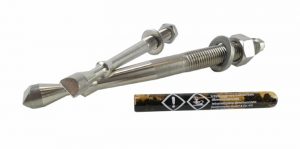
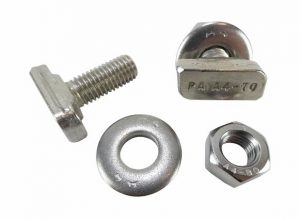
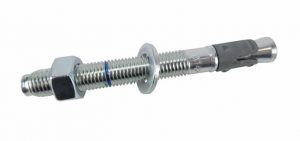
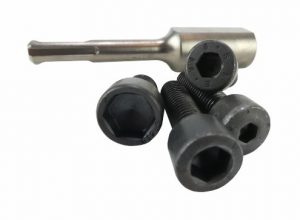
Of course, we always provide you with the right accessories and fasteners for the brackets, such as adhesive cartridges, hammerhead bolts, bolt anchors or screw-in adapters for mounting anchor rods.
Prefabricated veneer support
In addition to bracing and planning, we also offer prefabricated facing elements. These always match the selected brackets and thus form a static system. Your advantage: you only have one contact person for planning, brackets and prefabricated facing parts. Thanks to our many years of experience, we can not only offer standard lintels as stretcher or grenadier in all common stone formats, but also special prefabricated parts for a wide variety of façade designs, such as angled lintels, prefabricated parts for round or semi-circular windows, lower façade elevations or wall heads.
We have built particularly delicate precast elements such as pilaster strips with a cross-section of just 11.5 x 11.5 cm as well as very large precast elements such as balustrade panels over 165 cm high and 300 cm long, all with the necessary bracing!
In addition, we also offer you the usual special building articles for creating a facing façade, e.g.
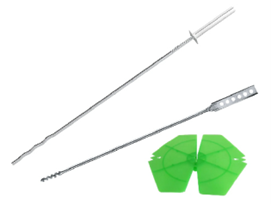
- Air layer anchorWhether dowel anchors for subsequent drilling, flat anchors for mortaring into the rear masonry or anchors for timber and aerated concrete walls, for shell spacings of up to 400 mm.
- Z-foil / EPDM lintel foil
- We offer complete systems with foil, primer and adhesive for base sealing, lintel sealing and as a masonry barrier.
- Support spindles
- For easy support of prefabricated veneer parts during installation.